![[IPWatchdog Logo]](https://ipwatchdog.com/wp-content/themes/IPWatchdog%20-%202023/assets/images/temp/logo-small@2x.png)
Patents Don’t Monetize Themselves: Turning Portfolios from Cost Centers into Revenue Assets
Imagine a company spends millions of dollars constructing a new office building in a prime downtown location. The company pays for maintenance, utilities, insurance, landscaping, repairs, security, and taxes. The building is well designed, professionally managed, and expensive to maintain. But it sits empty. No tenants. No leases. No revenue. That would strike most executives as irrational. Yet many companies treat patent portfolios in exactly the same way. They spend millions building and maintaining patent portfolios around the world. But when asked what revenue the portfolio generates, the silence is deafening.
Gene Quinn
8 hours ago
 0
0
![[Advertisement]](https://ipwatchdog.com/wp-content/uploads/2026/05/LexisNexis-Jun-11-2026-banner-1500x500-1.jpg)
Automating the Patent Process at the USPTO to Save Inventors Money
Have you ever drafted a claim set with a second claim that began, “the system of claim 2, wherein…” when you meant to write “the system of claim 1”? It’s embarrassing because every first-year patent attorney knows that a dependent patent claim cannot depend on itself. However, making the error is inevitable when you draft a large number of patent applications. The good news is, if you upload such a claim to today’s Patent Center (where patent applications are filed), you will be provided with the following alert: “The claims appear to contain an improper dependency with at least one claim that depends on a missing or canceled claim. Please review and revise if necessary”. How beautiful is this? Now you can self-correct before your patent application is even filed. Ten years ago, you would have to go back and forth with a patent examiner to correct the error.
John Powers
11 hours ago
0
CAFC Rejects Inventor’s Sotera Stipulation Challenge against LG, Affirms Google and Microsoft Win at PTAB
The U.S. Court of Appeals for the Federal Circuit (CAFC) issued a precedential decision Friday in Hafeman v. Google LLC affirming Patent Trial and Appeal Board (PTAB) final written decisions (FWDs) invalidating all claims of three related patents owned by inventor Carolyn Hafeman. The court also dismissed Hafeman’s argument that the inter partes reviews (IPRs) should have been terminated based on the district court’s finding that LG–a real party in interest to the IPRs–violated its Sotera stipulation.
Rose Esfandiari
12 hours ago
2
Readers React: What to Expect After the Supreme Court’s Hikma Ruling
Thursday’s Supreme Court ruling in Hikma v. Amarin has been discussed as a definitive win for the generics industry and may have implications beyond pharmaceutical and Hatch-Waxman cases. The Court criticized the U.S. Court of Appeals for the Federal Circuit (CAFC) for its trend of what the Court called focusing on “whether the relevant statements could be read by medical providers as instructions to infringe” when judging induced infringement in Hatch-Waxman cases. Below, stakeholders weigh in on the upshot of the ruling and what it means for pharmaceutical innovation going forward.
Eileen McDermott
June 7, 2026, 12:15 PM
1
What Shrinking Patent Budgets Say About the Patent System/ IPWatchdog Unleashed
I keep hearing the same thing from patent professionals across the industry—inside companies, inside law firms, and even from investors. Patent budgets are shrinking, expectations are rising, and nobody seems willing to admit what that combination actually means.
Gene Quinn
March 10, 2026, 12:15 PM
6
Arnold & Porter is Seeking a Senior Manager of IP Prosecution
Arnold & Porter is a leading international law firm with offices across the United States, Europe, and Asia. The firm delivers sophisticated regulatory, litigation, and transactional services to clients across a wide range of industries. Arnold & Porter is seeking a Senior Manager of IP Prosecution to join its Washington, DC office. This role provides firmwide leadership for the Intellectual Property Prosecution function, overseeing patent and trademark operations and ensuring the delivery of efficient, high-quality support to attorneys and clients.
JobOrtunities Help Wanted
April 9, 2026, 05:15 AM
0
Winning Patent Prosecution Work: Prove Value or Lose the Business | IPWatchdog Unleashed
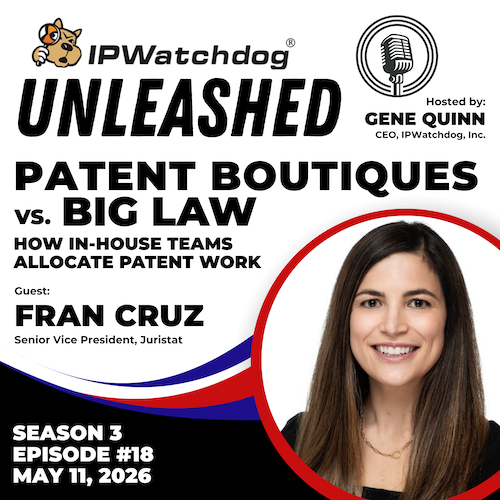
This week on IPWatchdog Unleashed, I spoke again with Fran Cruz, Senior Vice President of IP Solutions for Juristat. Our conversation was about a topic that should be top of mind for every patent prosecution firm, every in-house IP department, and every legal operations professional trying to make sense of the current market for patent related legal work. Where is patent prosecution work going, when does work move from firm to firm, when it does move, where is it moving, and what will firms have to do to win—or keep—the patent preparation and prosecution work?
Gene Quinn
May 11, 2026, 05:15 PM
1
Other Barks & Bites for Friday, June 5: Trump Auto Industry Comments Bolster REPAIR Act; House IP Subcommittee Debates Generics Legislation Following Hikma; and X Seeks Modification of FTC Order on Account Security
This Week in Other Barks & Bites: the Seventh Circuit remands a Schedule A trademark case to determine whether the Hague Convention’s terms on proper service apply to particular Chinese defendants; President Donald Trump criticizes the automotive industry’s alleged efforts to impede consumer choice on auto repairs; he Eleventh Circuit finds no valid copyright termination notice sent in a case involving members of 2 Live Crew; and more.
Steve Brachmann
June 5, 2026, 12:41 PM
0
Harrity & Harrity is Seeking a Patent Prosecution Attorney/Agent for 5G/6G
Harrity & Harrity, LLP is looking for remote (within the U.S.) or local patent professional superstars to prosecute 5G patent applications for leading global technology companies, including numerous Patent 300® companies.
JobOrtunities Help Wanted
June 5, 2026, 05:15 AM
0
Hikma Ruling Looms Large in House IP Subcommittee Hearing Debating Legislation Favoring Generic Drugmakers
At approximately the same moment that the U.S. Supreme Court handed down today’s landmark ruling in Hikma v. Amarin, the House Judiciary’s Subcommittee on Courts, Intellectual Property, Artificial Intelligence, and the Internet began a hearing on balancing medical innovation and access to generic drugs. Much of the hearing’s discussion was focused on proposed patent bills that favor generic drug makers–though whether they would ensure that Americans actually pay less for any drug, branded or otherwise, remains unclear.
Steve Brachmann
June 4, 2026, 06:07 PM
2
Patent Monetization: Markets, Misaligned Incentives, and the AI Inflection Point | IPWatchdog Unleashed
This week on IPWatchdog Unleashed, my conversation with patent broker Louis Carbonneau centers on a fundamental breakdown in the economic engine that has historically driven innovation. While innovation itself has not disappeared, the incentive structure that once enabled a repeatable cycle—innovate, patent, monetize, reinvest—has eroded. Large market participants increasingly operate under a “use now, pay later (if ever)” model, which disproportionately disadvantages individual inventors and smaller entities. As a result, many innovators are unable to sustain continued development beyond an initial breakthrough, leading to a systemic drag on long-term innovation output. This shift is reinforced by a broader cultural normalization of “free” access to intellectual property, which has migrated from the copyright into the patent and innovation industry.
Gene Quinn
April 7, 2026, 02:15 PM
2
SCOTUS Denies Petition Seeking Review of Second Circuit’s Trademark Co-Ownership Ruling
The U.S. Supreme Court on Monday denied certiorari in Zioness Movement, Inc. v. The Lawfare Project, Inc., a case in which Zioness Movement sought review of a U.S. Court of Appeals for the Second Circuit decision that upheld a jury verdict allowing two competing nonprofit entities to co-own the “Zioness” trademark.
Rose Esfandiari
March 10, 2026, 07:15 AM
0
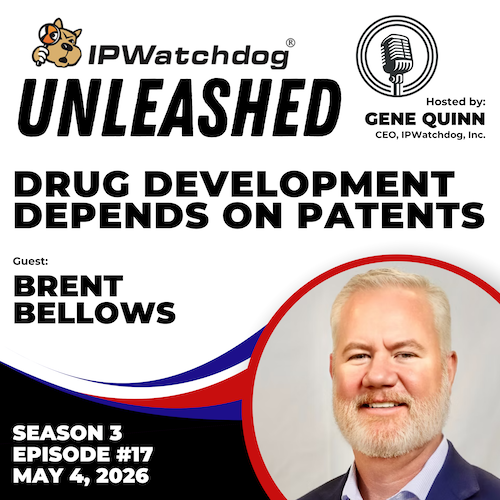
Patents, Drug Prices, Clinical Trials and the Economics of Medicine | IPWatchdog Unleashed
This week on IPWatchdog Unleashed, I spoke with Brent Bellows, a partner with Knowles Intellectual Property Strategies (KIPS). We discussed a variety of issues including Hatch-Waxman, Orange Book listings, paragraph IV certifications, skinny labels, generic entry, clinical trial costs, regulatory exclusivity, and the enormous financial risk associated with bringing new drugs to market. Gene and Brent explore the tension between public demand for lower drug prices and the need for durable incentives that make high-risk drug development economically viable, particularly for oncology, Alzheimer’s, Parkinson’s, antibiotic resistant bacteria, and other difficult-to-treat conditions. The episode closes with a broader innovation-policy message: patents are not a peripheral feature of drug development—they are a core operating asset that enables private-sector investment, supports breakthrough therapies, and ultimately drives the availability of future generic medicines.
Gene Quinn
May 4, 2026, 05:10 PM
1
Varsity Sponsors
![[Advertisement]](https://ipwatchdog.com/wp-content/uploads/2026/05/Protege-in-PatentSight-product-350x250-Ad-A.png)

Latest Podcasts


IPWatchdog Events
Webinar: How AI Is Transforming IP Strategy Across the Patent Lifecycle
June 11 @ 12:00 pm - 1:00 pm EDTWebinar: AI in Patent Drafting – When to Use Generative AI – and When Not To
June 25 @ 12:00 pm - 1:00 pm EDT
Subscribe to IPWatchdog
This is the best way to stay informed. We send a daily roundup of our latest news, press releases, and events.
Get Email Updates
Sponsored Content



Recent Podcasts
![[Advertisement]](https://ipwatchdog.com/wp-content/uploads/2021/12/WEBINAR-336-x-280-px.png)